On balance, we’re still doing less than nothing to stop global warming. News of the extinction event we’ve spawned has been abundant since 1988, yet tens of millions of us still insist there’s no problem, and almost no one – left, right, or center – has bothered to learn much about it. Overwhelming climate illiteracy guarantees continued inaction against global warming – which poses a mortal, imminent threat to life as we know it.
Consider the following items:
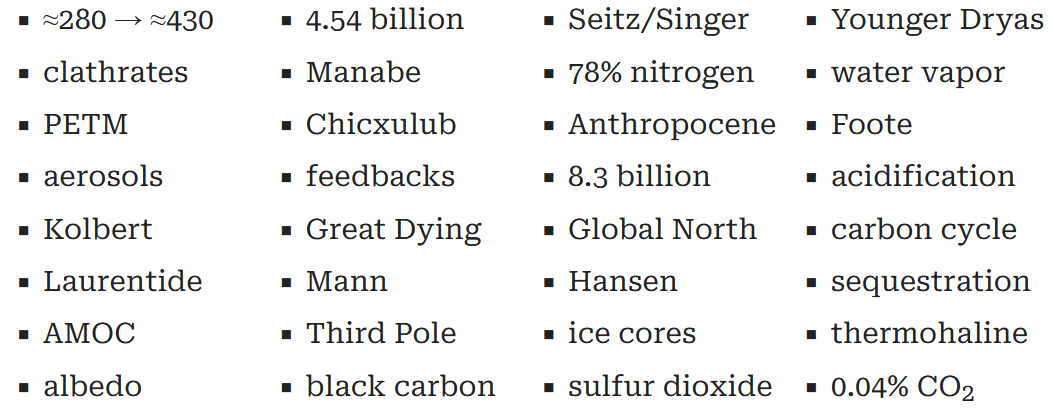
Were we to run any such collection of rock-bottom-basic climate essentials past 25 random citizens, we’d surely elicit at least 24 gazes as vacant as mine would’ve been before I took some advice:
It costs nothing other than time well spent to get up to speed with climate reality. One can choose from among thousands of worthwhile, easy-to-read books about climate. Your local library has dozens of them. Can’t find the one you want? A librarian can get it for you within a matter of days.
Or, to generate royalties for world-class climatologists and science journalists, buy their books. Buying books via the links below will also help facilitate the further development of this website.
If you follow a link and buy a book, Amazon may pay me a commission. Your price is unaffected.
In addition to its preponderance of pathetic dreck, YouTube offers a wealth of worthwhile, enjoyable content. Nevertheless, videos are the wrong tools for this job. Couldn’t be worse, really. Why do I say that?
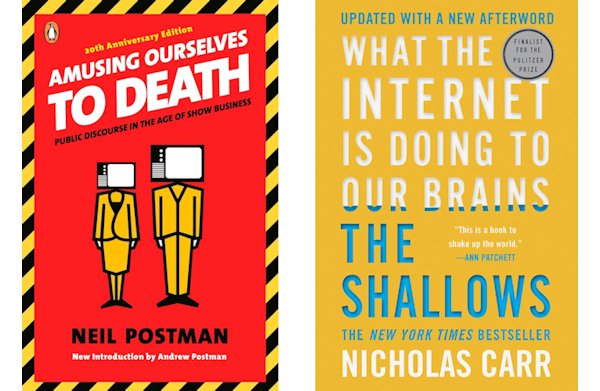
Two must-read classics explain it far better than I ever will: Amusing Ourselves To Death by Neil Postman and The Shallows by Nicholas Carr. What Postman said about TV over 40 years ago applies today – in spades – to YouTube, TikTok, et. al. The latest edition of The Shallows is © 2020. Chapter 7 is especially germane here. I re-read both books regularly and listen to them in audio editions – which raises two important points:
While traditional books are in some ways more conducive to learning than audiobooks, the utility of audio shouldn’t be overlooked. Sometimes it’s the best or even the only option – while driving, for example, or with a 20-minute shutoff timer at bedtime. Listening via Libby on iPad is remarkably convenient and costs nothing. Likewise library-provided CD audiobooks loaded (usually via computer) onto an mp3 player.
Whether one listens or reads to learn, periodic repetition’s a must. Read once, retain forever? Hardly. That’s not how how most minds work.
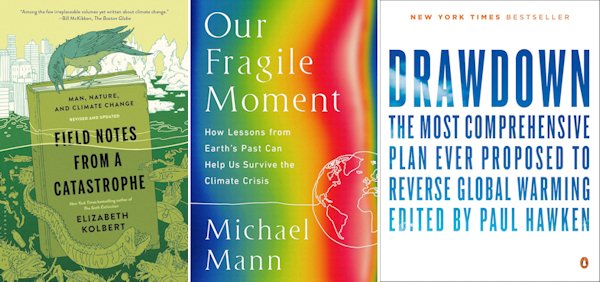
These three merit careful reading and re-reading – as if our lives depend on our retention of the basic facts books such as these present. Because life as we know it absolutely does depend on that.
Elizabeth Kolbert is arguably the 21st century’s preeminent climate journalist – and has been since Field Notes from a Catastrophe was first published in book form in 2006. Its publication had begun the previous year as a three-part series in The New Yorker. Kolbert re-issued the book with major additions and updates in 2015. Not only does that most recent edition remain one of the very best climate primers available, it presents the basic facts deliberately and with plenty of context and examples so as to enable non-scientists to ease into essential climate concepts comfortably – without being overwhelmed by them.
No other climatologist combines Michael E. Mann’s impeccable scientific credentials with general-audience communication skills and prolific publication (both academic and general-audience) practices and a relentless social media presence. As a result of his fusion of credentials with an astonishingly broad and constant public profile, if anyone can be regarded as the face of 21st-century climate science, it has to be Mann. His 2023 Our Fragile Moment presents a somewhat deeper dive into climate science (via a congenial review of basic paleoclimatology) than does Kolbert’s Field Notes, but it does so with a general, non-specialized audience in mind. And while Mann pulls no punches about the necessity of slashing emissions immediately, the book is surprisingly optimistic and decidedly, most refreshingly anti-doomism.
So what’s to be done about global warming? No single volume I’ve seen answers that question better or more extensively than does Paul Hawken’s Drawdown. There are dozens of suggestions that we, both individually and collectively, can and should pursue beginning right now. While not every reader will resonate with every suggestion, for every idea that might seem a little off, there will almost certainly be 10 more that will strike any fair-minded reader as spot-on. There’s also a website and organization that very significantly expands on the book’s scope.